



Learning Research & Science
Insights culled from analysis and inquiry that keep learning professionals up-to-date on how people learn, technologies, approaches, and performance improvement practices.
-

EMEA Reporter: Are Learning and HR Partners? Or Eternal Enemies?
As a learning professional, how do you view HR? David Wilson has spent 18 years watching how the relationship works and has come to some thought-provoking conclusions. Learn about how David is bridging the gap between the US and EMEA when it comes to research about learning, talent management, and HR.
-

Brain Science: Testing, Testing… The Whys and Whens of Assessment
Is it possible that your training is having no effect on learners, or worse, that it is actually detrimental to the good of the company? The answer is, “Yes, it is possible,” and until you conduct systematic assessment you will have no idea whether you are really helping your organization reach its goals. Here is some help from research.
-

Brain Science: Can Training Change Your Corporate Culture?
Some scandalous questions: What are the odds that your eLearning, by itself, will succeed at changing behavior? Put another way, “Does education matter?” Will teaching people new information really get them to behave in new ways? Art reveals some research that lay hidden for years, although it opens insights into what does and does not cause groups of people to change their behavior.
-

The eLearning Guild Releases 2015 Global eLearning Salary & Compensation Report
The eLearning Guild has released the 2015 Global eLearning Salary & Compensation Report. Based on data from more than 5,000 Guild members, the average base salary of an eLearning employee is $78,310. Make the most of new resources in the report to start your own research, access the Guild’s salary calculator, and develop an action plan to prepare for—and succeed in—future negotiations.
-
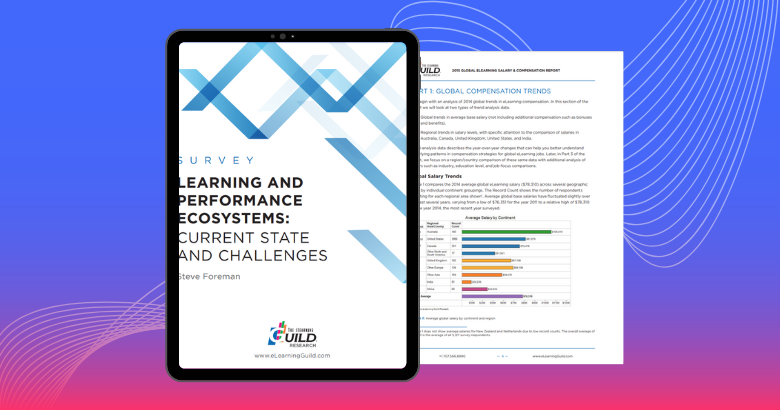
2015 Global eLearning Salary & Compensation Report
In this annual report, Sharon Vipond and Janet Clarey examine trends in pay for eLearning professionals, exploring global and regional salary trends and breaking down salary by variables including industry and company size.
-

Brain Science: Language and Its Many Meanings
It can happen that, in a class or in a discussion, people get into arguments and disagreements that keep everyone from making progress. Even worse, instead of learning, people only get frustrated, unhappy, and unproductive. Frequently, it turns out that the problem was that each person was using a particular word in a different way. Here’s a simple exercise to help get past this.
-

Design Tip: Productive Failure
Should learning be easy and effortless? Many designers approach their task under the assumption that it should be. However, research says otherwise: Struggle has long-term benefits for learning. Read about it here, and about how you can put the research findings into practice.
-

The Future of Training? Think Small
Large formal training programs feel tangible and impressive. Unfortunately, they may also be cumbersome, inefficient, and quickly outdated. Research also indicates that optimal learner focus only lasts about 10 to 18 minutes. “Microlearning” can make content more visible, extendable, reusable, and up to date while offering minimal disturbance to the daily work schedule. Read about it here!
-

Brain Science: Are Learning Styles Valid?
During the last 30 years, the notion of learning styles has become popular in corporate training. This month’s column explores the concept of learning styles and examines the evidence about its pedagogical effectiveness.
-

Design Tip: Vicarious Learning
Is interactive always better? Hands-on modules are great when teaching technical skills, but what about nuanced topics like effective communication or price negotiation? A recent study suggests that certain subjects benefit more from “vicarious” learning. Sometimes watching trumps doing. Read about it here!